



01 The story
During the London 2012 Olympics, several teams began experimenting with larger chainrings and sprockets in the pursuit of marginal gains from improved mechanical efficiency. It soon became evident, after the Rio 2016 Olympics, that track cycling had evolved to the point where big chainrings were not just a passing trend, but a necessity. Most track sprinters were already using 13T or 12T rear cogs, along with front chainrings boasting 60 teeth or more, in order to remain competitive. By 2020, top speeds in the Flying 200m event had reached 80 km/h, ushering in the era of 65-70T chainrings, which are truly enormous.
We have now reached a critical juncture where the old standards no longer align with modern requirements. The 144 mm Bolt Circle Diameter standard, introduced nearly 60 years ago in the mid-1960s, functioned well with commonly used 48-53T chainrings, but is unable to accommodate the demands of the 60T+ chainrings used today.
02 How it started
In 2019, as part of our development process for our world record-setting Supersport chainring, we initiated the 200 BCD project. Collaborating closely with various national teams, we discovered serious issues arising from the use of large chainrings, leading to a significant decline in drivetrain performance. It became evident that if we wanted to enhance the performance of track bicycles, we needed to tackle the root causes of these problems.
03 Chainring runout
One such issue is the presence of lateral and radial runouts. Our imperfect world means that perfect straightness simply does not exist. Both crank arms and chainrings possess non-flatness stemming from manufacturing and material imperfections, resulting in runout at the tooth profile. While this issue does not affect road bicycles due to the chain tensioner in the rear derailleur, it poses a significant challenge for track bicycles.

04 The lack of chainring stiffness
The second significant issue concerns the lack of chainring stiffness. This issue may not be apparent during the bike assembly process, but when powerful riders exert maximum effort, generating 1500-2500 watts, every component of the bike, including the chainring, undergoes flexion. This flexion results in chain rub against the sides of the teeth, further diminishing drivetrain performance. Larger chainrings exhibit more significant flex. Although we mitigated this issue to some extent in our Supersport chainring by incorporating a honeycomb structure, it was not enough to completely eliminate the problem.
Compounding the issue, many riders have adopted carbon chainrings, which exhibit even greater flex compared with aluminum, often unaware of the substantial wattage losses they suffer. This flex compromises power transfer and further reduces performance. It became evident to us that the time had come to replace the outdated 144 mm BCD standard with a solution better suited to modern demands.

05 Development
Throughout the development of our prototypes, two key factors required consideration: the chainring sizes commonly used by track cyclists and the frames they used. In essence, we needed to ensure that the crankset would accommodate the desired chainrings while providing adequate clearance for various chainstays.
We discovered that male track sprinters typically use chainrings ranging from 63 to 68T, while their female counterparts opt for sizes between 58 and 62T. Most frames developed after 2019 could easily accommodate these larger chainrings without any clearance issues. Nevertheless, clearance remained an important factor in our design process.
After two years of prototyping and development, we are delighted to present the result of our efforts.
06 The result
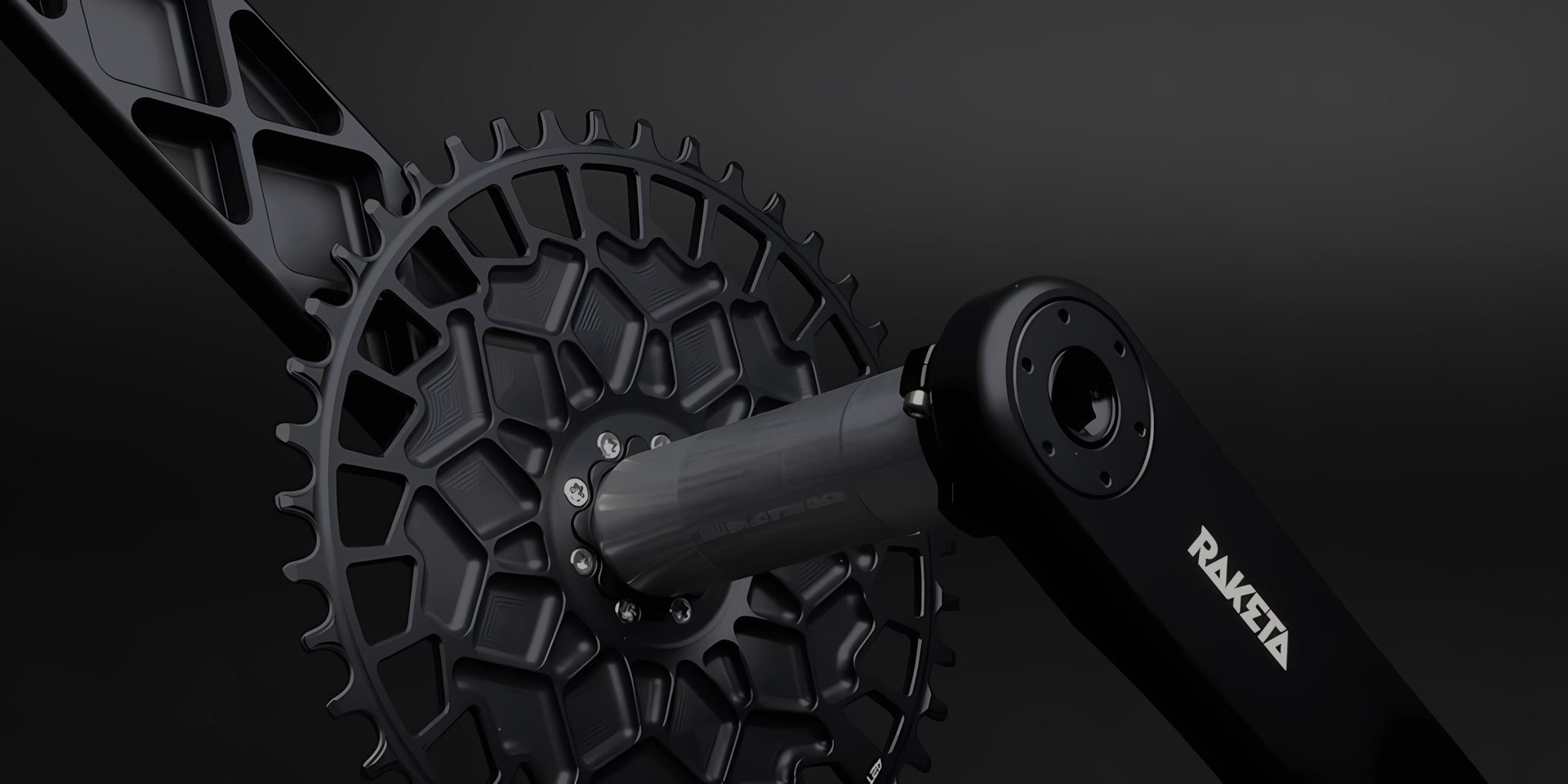
We proudly introduce the Raketa 200 BCD crankset system. The 200 mm BCD may sound like an imposing size, but when you see the pictures with a 65T chainring installed, the overall aesthetics come into perfect harmony.
Yet it is the numbers that truly highlight the breakthrough achieved.
With a 65T chainring installed, the Raketa 200 BCD crankset weighs 951 grams, compared with the 892 grams of the Raketa 144 BCD cranks and Raketa 65T Supersport chainring combination. Despite a weight increase of just 6.5%, our new system increases the stiffness of the 65T chainring fivefold and improves overall drivetrain stiffness by 25% when compared with the already sturdy Raketa 144 BCD cranks. These advancements translate to a potential saving of up to 30 watts at a speed of 65 km/h compared with track cranksets offered by other manufacturers.
07 The product
Our quest did not stop at developing and validating the principles; we were determined to transform them into a final product without compromising quality.
The driveside crank arm is CNC-machined from a solid 6-kilogram block of ultra-high-grade 7000-series aluminum, surpassing the popular 7075-T6 alloy in strength and durability. This same alloy is used in the wings of Boeing airplanes, reaffirming its standing in both the bicycle and aerospace industries.
Crankarms and chainrings undergo precision CNC machining on an AgieCharmilles machining center to guarantee exceptional straightness and minimize runouts. Our axles and bottom brackets are meticulously machined in-house, ensuring minimal friction within the bearings and resulting in almost zero wattage loss.
Even the smallest components of the crankset, the chainring bolts, have received careful attention. We increased their number from five to seven, providing a more solid and uniform mount. We also incorporated a triangular interlocking interface to secure the bolts and simplify chainring replacement.

08 Product purchase
The Raketa 200 BCD crankset is designed to be used by elite athletes operating at the highest level. We offer comprehensive product data and support to national squads and professional private teams.
Every Raketa 200 BCD crankset is made to order, tailored to the precise specifications of individual riders. Customization options include crank length, colors, and chainring sizes. Cranksets are dispatched within 60 days of invoice payment.
09 Licensing
We, the creators of the Raketa 200 BCD system, have no intention of keeping it as a proprietary or patented solution. Our aim is to contribute to the world of track cycling, pushing the boundaries of human performance and striving to achieve future records.
Starting from August 2024, we are open to licensing the Raketa 200 BCD system. Licensing will be free of charge and free from royalty fees. Chainring and crankset manufacturers interested in incorporating this innovative system into their own products and gaining access to all the necessary data are encouraged to contact us via support@raketacomponents.com.
Together, let us shape the future of track cycling.
